Issue 75, Spring 1979
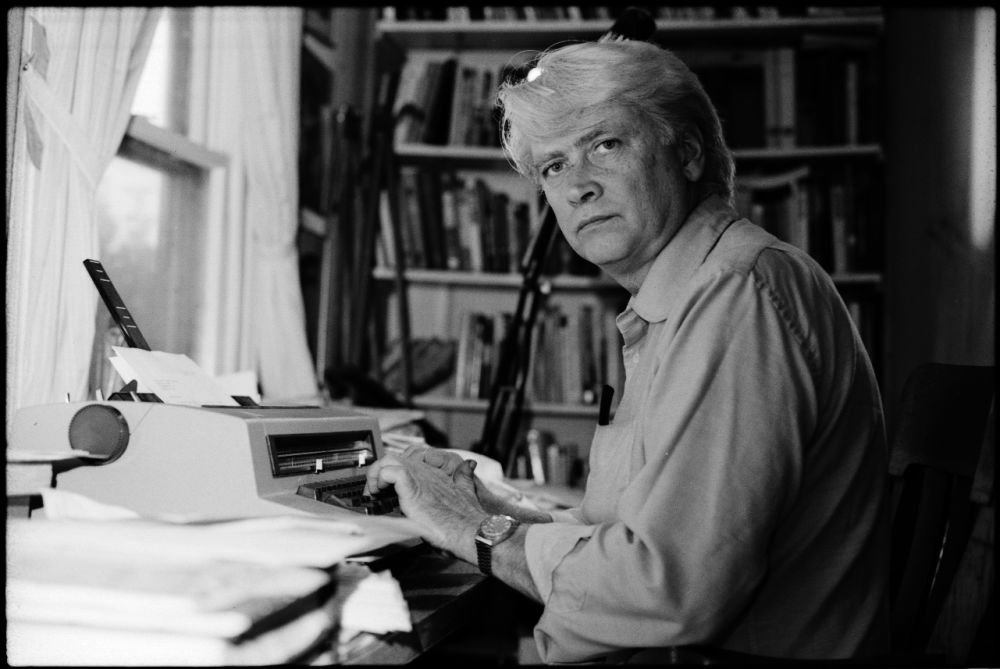
The following interview incorporates three done with John Gardner over the last decade of his life. After interviewing him in 1971, Frank McConnell wrote of the thirty-nine-year-old author as one of the most original and promising younger American novelists. His first four novels—The Resurrection (1966), The Wreckage of Agathon (1970), Grendel (1971), and <
The following interview incorporates three done with John Gardner over the past decade. In his introduction(1971) Frank MConnell wrote of the thirty-nine-year-old author as one of the most original and promising younger American novelists. His four novels—The Resurrection (1966), The Wreckage of Agathon (1970), Grendel (1971), and The Sunlight Dialogues (1972)—represent, in the eyes of many critics and reviewers, a new and exhilarating phase in the enterprise of modern writing, a consolidation of the resources of the contemporary novel and a leap forward—or backward—into a reestablished humanism. One finds in his books elements of the three major strains of current fiction: the elegant narrative gamesmanship of Barth or Pynchon, the hyperrealistic gothicism of Joyce Carol Oates and Stanley Elkin, and the cultural, intellectual history of Saul Bellow. Like so many characters in current fiction, Gardner’s are men on the fringe, men shocked into the consciousness that they are living lives that seem to be determined, not by their own will, but by massive myths, cosmic fictions over which they have no control (e.g., Ebeneezer Cooke in Barth’s Sot-Weed Factor, Tyrone Slothrop in Pynchon’s Gravity’s Rainbow); but Gardner’s characters are philosophers on the fringe, heirs, all of them, to the great debates over authenticity and bad faith that characterize our era. In Grendel, for example, the hero-monster is initiated into the Sartrean vision of Nothingness by an ancient, obviously well-read dragon: a myth speaking of the emptiness of all myths—“Theory-makers… They’d map out roads through Hell with their crackpot theories, their here-to-the-moon-and-back lists of paltry facts. Insanity—the simplest insanity ever devised!” His heroes—like all men—are philosophers who are going to die; and their characteristic discovery—the central creative energy of Gardner’s fiction—is that the death of consciousness finally justifies consciousness itself. The myths, whose artificiality contemporary writers have been at such pains to point out, become in Gardner’s work real and life giving once again, without ever losing their modern character of fictiveness.
Gardner may well represent, then, the new “conservatism,” which some observers have noted in the current scene. But it is a conservatism of high originality, and, at least in Gardner’s case, of deep authority in his life. A Ph.D. in Medieval Literature (Universty of Iowa), Gardner has taught academic courses throughout his novelistic career, and published, besides his fictions, two widely respected annotated translations of medieval poetry and a healthy (i.e. tenure-making) number of scholarly articles. When he recently guest-taught a course in “Narrative Forms” at Northwestern University, a number of his students were surprised to find a modern writer—and a hot property—enthusiastic, not only about Homer, Virgil, Apollonius Rhodius, and Dante, but deeply concerned with the critical controversies surrounding those writers, and with mistakes in their English translations. As the interview following makes clear, Gardner’s job in and affection for ancient writing and the tradition of metaphysics is, if anything, greater than for the explosions and involutions of modern fiction. He is, in the full sense of the word, a literary man.
“It’s as if God put me on earth to write,” Gardner observed once. And writing, or thinking about writing, takes up much of his day. He works, he says, usually on three or four books at the same time, allowing the plots to cross-pollinate, shape and qualify each other. And, at this writing, he has three more books ready for publication: Jason and Medeia, an epic poem, Nickel Mountain, a novel, and King’s Indian, a collection of tales.
Sara Matthiessen describes Gardner in the spring of 1978 (additional works published by then included October Light, a novel; his treatise On Moral Fiction was about to be published). Matthiessen arrived with a friend to interview him at the Breadloaf Writer’s Colony in Vermont: “After we’d knocked a couple of times, he opened the door looking haggard and just wakened. Dressed in a purple sateen, bell-sleeved, turtleneck shirt and jeans, he was an exotic figure: unnaturally white hair to below his shoulders, of medium height, he seemed an incarnation from the medieval era central to his study. ‘Come in!’ he said, as though there were no two people he’d rather have seen than Sally and me, and he led us into a cold, bright room sparsely equipped with wooden furniture. We were offered extra socks against the chill. John lit his pipe, and we sat down to talk.”
INTERVIEWER
You’ve worked in several different areas: prose, fiction, verse, criticism, book reviews, scholarly books, children’s books, radio plays; you wrote the libretto for a recently produced opera. Could you discuss the different genres? Which one have you most enjoyed doing?
JOHN GARDNER
The one that feels the most important is the novel. You create a whole world in a novel and you deal with values in a way that you can’t possibly in a short story. The trouble is that since novels represent a whole world, you can’t write them all the time. After you finish a novel, it takes a couple of years to get in enough life and enough thinking about things to have anything to say, any clear questions to work through. You have to keep busy, so it’s fun to do the other things. I do book reviews when I’m hard up for money, which I am all the time. They don’t pay much, but they keep you going. Book reviews are interesting because it’s necessary to keep an eye on what’s good and what’s bad in the books of a society worked so heavily by advertising, public relations, and so on. Writing reviews isn’t really analytical, it’s for the most part quick reactions—joys and rages. I certainly never write a review about a book I don’t think worth reviewing, a flat-out bad book, unless it’s an enormously fashionable bad book. As for writing children’s books, I’ve done them because when my kids were growing up I would now and then write them a story as a Christmas present, and then after I became sort of successful, people saw the stories and said they should be published. I like them, of course. I wouldn’t give junk to my kids. I’ve also done scholarly books and articles. The reason I’ve done those is that I’ve been teaching things like Beowulf and Chaucer for a long time. As you teach a poem year after year, you realize, or anyway convince yourself, that you understand the poem and that most people have got it slightly wrong. That’s natural with any poem, but during the years I taught lit courses, it was especially true of medieval and classical poetry. When the general critical view has a major poem or poet badly wrong, you feel like you ought to straighten it out. The studies of Chaucer since the fifties are very strange stuff: like the theory that Chaucer is a frosty Oxford-donnish guy shunning carnality and cupidity. Not true. So close analysis is useful. But writing novels—and maybe opera libretti—is the kind of writing that gives me greatest satisfaction; the rest is more like entertainment.
INTERVIEWER
You have been called a “philosophical novelist.” What do you think of the label?
GARDNER
I’m not sure that being a philosophical novelist is better than being some other kind, but I guess that there’s not much doubt that, in a way at least, that’s what I am. A writer’s material is what he cares about, and I like philosophy the way some people like politics, or football games, or unidentified flying objects. I read a man like Collingwood, or even Brand Blanchard or C. D. Broad, and I get excited—even anxious—filled with suspense. I read a man like Swinburn on time and space and it becomes a matter of deep concern to me whether the structure of space changes near large masses. It’s as if I actually think philosophy will solve life’s great questions—which sometimes, come to think of it, it does, at least for me. Probably not often, but I like the illusion. Blanchard’s attempt at a logical demonstration that there really is a universal human morality, or the recent flurry of theories by various majestical cranks that the universe is stabilizing itself instead of flying apart—those are lovely things to run into. Interesting and arresting, I mean, like talking frogs. I get a good deal more out of the philosophy section of a college bookstore than out of the fiction section, and I more often read philosophical books than I read novels. So sure, I’m “philosophical,” though what I write is by no means straight philosophy. I make up stories. Meaning creeps in of necessity, to keep things clear, like paragraph breaks and punctuation. And, I might add, my friends are all artists and critics, not philosophers. Philosophers—except for the few who are my friends—drink beer and watch football games and defeat their wives and children by the fraudulent tyranny of logic.
INTERVIEWER
But insofar as you are a “philosophical novelist,” what is it that you do?
GARDNER
I write novels, books about people, and what I write is philosophical only in a limited way. The human dramas that interest me—stir me to excitement and, loosely, vision—are always rooted in serious philosophical questions. That is, I’m bored by plots that depend on the psychological or sociological quirks of the main characters—mere melodramas of healthy against sick—stories that, subtly or otherwise, merely preach. Art as the wisdom of Marcus Welby, M.D. Granted, most of fiction’s great heroes are at least slightly crazy, from Achilles to Captain Ahab, but the problems that make great heroes act are the problems no sane man could have gotten around either. Achilles, in his nobler, saner moments, lays down the whole moral code of The Iliad. But the violence and anger triggered by war, the human passions that overwhelm Achilles’s reason and make him the greatest criminal in all fiction—they’re just as much a problem for lesser, more ordinary people. The same with Ahab’s desire to pierce the Mask, smash through to absolute knowledge. Ahab’s crazy, so he actually tries it; but the same Mask leers at all of us. So, when I write a piece of fiction I select my characters and settings and so on because they have a bearing, at least to me, on the old unanswerable philosophical questions. And as I spin out the action, I’m always very concerned with springing discoveries—actual philosophical discoveries. But at the same time I’m concerned—and finally more concerned—with what the discoveries do to the character who makes them, and to the people around him. It’s that that makes me not really a philosopher, but a novelist.
INTERVIEWER
The novel Grendel is a retelling of the Beowulf story from the monster’s point of view. Why does an American writer living in the twentieth century abandon the realistic approach and borrow such legendary material as the basis for a novel?
GARDNER
I’ve never been terribly fond of realism because of certain things that realism seems to commit me to. With realism you have to spend two hundred pages proving that somebody lives in Detroit so that something can happen and be absolutely convincing. But the value systems of the people involved is the important thing, not the fact that they live on Nine Mile Road. In my earlier fiction I went as far as I could from realism because the easy way to get to the heart of what you want to say is to take somebody else’s story, particularly a nonrealistic story. When you tell the story of Grendel, or Jason and Medeia, you’ve got to end it the way the story ends— traditionally, but you can get to do it in your own way. The result is that the writer comes to understand things about the modern world in light of the history of human consciousness; he understands it a little more deeply, and has a lot more fun writing it.
INTERVIEWER
But why specifically Beowulf?
GARDNER
Some stories are more interesting than others. Beowulf is a terribly interesting story. It gives you some really wonderful visual images, such as the dragon. It’s got Swedes looking over the hills and scaring everybody. It’s got mead halls. It’s got Grendel, and Grendel’s mother. I really do believe that a novel has to be a feast of the senses, a delightful thing. One of the better things that has happened to the novel in recent years is that it has become rich. Think of a book like Chimera or The Sot-Weed Factor—they may not be very good books, but they are at least rich experiences. For me, writers like John O’Hara are interesting only in the way that movies and tv plays are interesting; there is almost nothing in a John O’Hara novel that couldn’t be in the movies just as easily. On the other hand, there is no way an animator, or anyone else, can create an image from Grendel as exciting as the image in the reader’s mind: Grendel is a monster, and living in the first person, because we’re all in some sense monsters, trapped in our own language and habits of emotion. Grendel expresses feelings we all feel—enormous hostility, frustration, disbelief, and so on, so that the reader, projecting his own monster, projects a monster that is, for him, the perfect horror show. There is no way you can do that in television or the movies, where you are always seeing the kind of realistic novel O’Hara wrote… Gregory Peck walking down the street. It’s just the same old thing to me. There are other things that are interesting in O’Hara, and I don’t mean to put him down excessively, but I go for another kind of fiction: I want the effect that a radio play gives you or that novels are always giving you at their best.
INTERVIEWER
You do something very interesting in Grendel. You never name Beowulf, and in the concluding scene you describe him in such a way as to give the impression that Grendel is really confronting, not Beowulf or another human being, but the dragon. That seems a significant change from the poem.
GARDNER
I didn’t mean it to be a change. As a medievalist, one knows there are two great dragons in medieval art. There’s Christ the dragon, and there’s Satan the dragon. There’s always a war between those two great dragons. In modern Christian symbolism a sweeter image of Jesus with the sheep in his arms has evolved, but I like the old image of the warring dragon. That’s not to say Beowulf really is Christ, but that he’s Christ-like. Actually, he is many things. When Grendel first sees Beowulf coming, Grendel thinks of him as a sort of machine, and what comes to the reader’s mind is a kind of computer, a spaceman, a complete alien, unknown. The inescapable mechanics of the universe. At other times, Beowulf looks like a fish to Grendel. He comes in the season of Pisces when, among other things, you stab yourself in the back. On other occasions, Grendel sees other things, one after another, and for a brief flash, when he is probably hallucinating—he’s fighting, losing blood very badly because he has his arm torn off—Grendel thinks he’s fighting the dragon instead of Beowulf. At the end of the story, Grendel doesn’t know who he’s fighting. He’s just fighting something big and horrible and sure to kill him, something that he could never have predicted in the universe as he understood it, because from the beginning of the novel, Grendel feels himself hopelessly determined, hopelessly struggling against—in the profoundest sense—the way things are. He feels there’s no way out, that there’s no hope for living consciousness, particularly his consciousness, since, for reasons inexplicable to him, he’s on the wrong side, Cain’s side instead of mankind’s.
INTERVIEWER
It seems to me that determinism is affliction imposed on him by the scop.
GARDNER
It’s true, but only partly. In the novel, he’s undeniably pushed around by the universe, but also not to believe, not to have faith in life. What happens is, in the story, the shaper, the scop, the court poet comes to this horrible court that’s made itself what it is by killing everybody, beating people, chopping them to death, and the poet looks at this havoc around him and makes up a story about what a wonderful court it is, what noble ideals it has. The courtiers are just dumb enough to believe it, just as Americans have believed the stories about Sam Adams and Ethan Allen and all those half-mythical heroes. George Washington once stood for thirty minutes stuttering in a rage before executing a private for a minor misdeed. Sam Adams was like a well-meaning Marxist agitator. Constantly lied. He told Boston that New York had fallen when it hadn’t fallen. Or anyway so one of my characters claims. I no longer remember what the truth is.
INTERVIEWER
But that’s an important moment in Grendel’s development, isn’t it, when he hears this story?
GARDNER
He hears the story and is tempted to believe it. And for certain reasons, partly because he is kicked out of the mead hall, he decides to reject the myth. That’s Grendel’s hard luck, because when he goes to the mead hall and wants to be a good monster and doesn’t want to kill people anymore, Hrothgar’s warriors don’t know that, and they throw spears at him and hurt him.
INTERVIEWER
You don’t see yourself, as a novelist, analogous to the scop in the telling of a story?
GARDNER
Oh, sure. Absolutely. I absolutely believe every artist is in the position of the scop. As I tried to make plain in On Moral Fiction, I think that the difference right now between good art and bad art is that the good artists are the people who are, in one way or another, creating, out of deep and honest concern, a vision of life in the twentieth century that is worth pursuing. And the bad artists, of whom there are many, are whining or moaning or staring, because it’s fashionable, into the dark abyss. If you believe that life is fundamentally a volcano full of baby skulls, you’ve got two main choices as an artist: You can either stare into the volcano and count the skulls for the thousandth time and tell everybody, “There are the skulls; that’s your baby, Mrs. Miller.” Or you can try to build walls so that fewer baby skulls go in. It seems to me that the artist ought to hunt for positive ways of surviving, of living. You shouldn’t lie. If there aren’t any, so far as you can see, you should say so, like the Merdistes. But I don’t think the Merdistes are right—except for Céline himself, by accident, because Céline (as character, not as author) is comic; a villain so outrageous, miserable, and inept that we laugh at him and at all he so earnestly stands for. I think the world is not all merde. I think it’s possible to make walls around at least some of the smoking holes.
INTERVIEWER
Won’t this have the effect of transforming the modern writer into a didactic writer?
GARDNER
Not didactic. The didactic writer is anything but moral because he is always simplifying the argument, always narrowing away, getting rid of legitimate objections. Mein Kampf is a moralistic book—a stupid, ugly one. A truly moral book is one that is radically open to persuasion, but looks hard at a problem, and keeps looking for answers. It gives you an absolutely clear vision, as if the poet, the writer, had nothing to do with it, had just done everything in his power to imagine how things are. It’s the situation of Dostoyevsky and Nietzsche—an illusion I use in On Moral Fiction. Nietzsche sets up this abstract theory of the Superman according to which a person can kill or do anything he wants because there is no basis of law except the herd. God doesn’t speak; dead. So the people get together and vote to have a red light on Highway 61 where there’s no traffic. It’s three o’clock in the morning. You’re traveling, and there’s a red light, and you decide to jump the light. A car pulls out of the weeds, a policeman, and he comes after you. If you’re a superman, you politely and gently kill him, put him back in the weeds, and drive on. The theory of the superman is kind of interesting, abstractly. The question is, is it right? Will it work? Can human beings live with it? So Dostoyevsky sets up the experiment imaginatively. Obviously he doesn’t want to go out and actually kill somebody to see if it works, so he imagines a perfectly convincing St. Petersburg, and a perfectly convincing person who would do this. (What student in all St. Petersburg would commit a murder? What relatives would he have? What friends? What would his pattern be? What would he eat?) Dostoyevsky follows the experiment out and finds out what does happen.
I think all great art does this, and you don’t have to do it realistically. Obviously Raskolnikov could have been a giant saurian, as long as his character is consistent and convincing, tuned to what we know about actual feeling. The point is realism of imagination, convincingness of imagination. The novelist pursues questions, and pursues them thoroughly. Not only when does it rain and when doesn’t it rain, but can we tolerate rain? What can we be made to tolerate? What should we not allow ourselves to be made to tolerate? And so on. So that finally, what’s moral in fiction is chiefly its way of looking. The premise of moral art is that life is better than death; art hunts for avenues to life. The book succeeds if we’re powerfully persuaded that the focal characters, in their fight for life, have won honestly or, if they lose, are tragic in their loss, not just tiresome or pitiful.
INTERVIEWER
So you have a strong sense of mission, or of a goal, in modern fiction.
GARDNER
Yes, I do. In my own way, anyway. I want to push the novel in a new direction, or back to an old one—Homer’s or the Beowulf poet’s. Of course, a lot of other writers are trying to do something rather different—Barth and Pynchon, I grant them their right—grudgingly. But to paraphrase the Imagists, I want “no ideas but in energeia”—Aristotle’s made-up word for (excuse the jazz), “the actualization of the potential which exists in character and situation.” Philosophy as plot. I think no novel can please for very long without plot as the center of its argument. We get too many books full of meaning by innuendo—the ingenious symbol, the allegorical overlay, stories in which events are of only the most trivial importance, just the thread on which the writer strings hints of his “real” meaning. This has been partly a fault of the way we’ve been studying and teaching literature, of course. Our talk of levels and all that. For instance, take John Updike’s Couples. It’s a fairly good book, it seems to me, but there’s a good reason no one reads it anymore: contrived phrases bear all the burden. Symbolically constructed names; descriptions of a living room that slyly hint at the expansion of the universe; or Updike’s whole cunning trick with Christian iconography, circles and straight lines—circles traditionally associated with reason, straight lines with faith. You work the whole symbolic structure out and you’re impressed by Updike’s intelligence—maybe, in this book, even wisdom—but you have difficulty telling the fornicators apart. Reading Couples is like studying science while watching pornographic movies put together from random scraps on the cutting-room floor.
INTERVIEWER
You want novels to be whole entertainments, then.
GARDNER
Sure! Look: It’s impossible for us to read Dostoyevsky as a writer of thrillers anymore, because of this whole weight of explanation and analysis we’ve loaded on the books. And yet The Brothers Karamazov is obviously, among other things, a thriller novel. (It also contains, to my mind, some pretentious philosophizing.) What I’ve wanted to do, in The Sunlight Dialogues, for example, is write a book—maybe not a novel—that you could read as entertainment. Where there’s straight philosophizing, here as in The Resurrection, it’s present because that’s what the character would say (or so I thought at the time), present because that’s what makes him behave as he does. No meaning but emotion-charged action and emotional reaction.
INTERVIEWER
The classical forms, like Grendel, are not your only models, nor do you always adhere to the superficial nature of the form you’ve chosen—for instance, there are parts in the Sunlight Dialogues that parody Faulkner.
GARDNER
Sure. In fact, the whole conception of the book is in a way parodic of Faulkner, among others—the whole idea of family and locale. A lot of times I’ve consciously taken a writer on. In the first novel I did, I used the title The Resurrection to give the reader a clue as to what’s wrong with Tolstoy in his Resurrection. I don’t think many readers notice, and of course it doesn’t matter. In fact, a friend of mine who’s a very good critic asked me one time if I were aware that I’d used a title that Tolstoy had used. That’s all right. If I sounded too much like Tolstoy, then my novel would be a critical footnote.
INTERVIEWER
How about your contemporaries? Has any of their work influenced your writing?
GARDNER
Of course I’m aware of modern writers… and some writers have changed my way of thinking. I don’t always like what Bill Gass does—though I do immensely like much of his fiction—but I certainly have changed my writing style because of his emphasis on language, that is, his brilliant use of it in books. It has always seemed to me that the main thing you ought to be doing when you write a story is, as Robert Louis Stevenson said, to set a “dream” going in the reader’s mind… so that he opens the page, reads about three words, and drops into a sort of trance. He’s seeing Russia instead of his living room. Not that he’s passive. The reader hopes and judges. I used to think that words and style should be transparent, that no word should call attention to itself in any way; that you could say the plainest thing possible to get the dream going. After I read some early Gass—“The Pedersen Kid,” I think—I realized that you don’t really interfere with the dream by saying things in an interesting way. Performance is an important part of the show. But I don’t, like Gass, think language is of value when it’s opaque, more decorative than communicative. Gass loves those formalist arguments. He’s said, for instance, that it’s naïve to think of characters as real—that it’s absurd to cry for little Nell. It may be absurd to cry at that particular death, because in that case the writing is lousy. But what happens in real fiction is identical to what happens in a dream—as long as we have the right to wake up screaming from a nightmare, we have the right to worry about a character. Gass has a funny theory. But I have borrowed a great many elements from it—I’m sure I owe more to him than to any other living writer. And I have learned a few things from slightly contemporary writers. About symbols, for instance. If you stop with James Joyce, you may write a slightly goofy kind of symbolic novel. Joyce’s fondness for the “mannered” is the least of it. At the time Joyce was writing, people were less attuned than they are now to symbolic writing, so he sometimes let himself get away with bald, obvious symbols. Now, thanks largely to the New Criticism, any smart college freshman can catch every symbol that comes rolling along. The trouble is that if a reader starts watching the play of symbolism and missing what’s happening to the characters, he gets an intellectual apprehension of the book, and that’s pretty awful. He might as well read philosophy or meditations on the wounds of Christ. But you still need resonance, deep effect. You have to build into the novel the movement from particular to general. The question is, how do you get a symbolic structure without tipping your hand? A number of modern writers have shown ways of doing it. The red herring symbols of Pynchon, the structural distractions of Barth, the machine-gun energy of Gaddis. Above all, Gass’s verbal glory.
INTERVIEWER
Do you, like Joyce, play to the reader subliminally through symbolism, or do you make fairly overt statements by demonstrating what certain values can lead to?
GARDNER
I try to be as overt as possible. Plot, character, and action first. I try to say everything with absolute directness so that the reader sees the characters moving around, sees the house they’re moving through, the landscape, the weather, and so on. I try to be absolutely direct about moral values and dilemmas. Read it to the charwoman, Richardson said. I say, make it plain to her dog. But when you write fiction such as mine, fantastic or quasi-realistic fiction, it happens inevitably that as you’re going over it, thinking about it, you recognize unconscious symbols bubbling up to the surface, and you begin to revise to give them room, sort of nudge them into sight. Though ideally the reader should never catch you shaking a symbol at him. (Intellect is the chief distractor of the mind.) The process of writing becomes more and more mysterious as you go over the draft more and more times; finally everything is symbolic. Even then you keep pushing it, making sure that it’s as coherent and self-contained as a grapefruit. Frequently, when you write a novel you start out feeling pretty clear about your position, what side you’re on; as you revise, you find your unconscious pushing up associations that modify that position, force you to reconsider.
INTERVIEWER
You began October Light, you’ve said, with the idea that “the traditional New England values are the values we should live by: good workmanship, independence, unswerving honesty—” but these proved oversimple. Is the process of fiction always the process of discovery for you? In other words, do you often find that the idea that prompted the fiction turns out to be too simple, or even wrong?
GARDNER
I always start out with a position I later discover to be too simple. That’s the nature of things—what physicists call complementarity. What’s interesting is that my ideas prove too simple in ways I could never have anticipated. In everything I’ve written I’ve come to the realization that I was missing something, telling myself lies. That’s one of the main pleasures of writing. What I do is follow the drama where it goes; the potential of the characters in their given situation. I let them go where they have to go, and analyze as I’m going along what’s involved, what the implications are. When I don’t like the implications, I think hard about it. Chasing implications to the wall is my one real skill. I think of ways of dramatically setting up contrasts so that my position on a thing is clear to me, and then I hound the thing till it rolls over. I certainly wouldn’t ever fake the actions, or the characters, or make people say what they wouldn’t say. I never use sleight of wits like Stanley Elkin—though no one can fail to admire a really good sophist’s skill.
INTERVIEWER
How important is setting?
GARDNER
Setting is one of the most powerful symbols you have, but mainly it serves characterization. The first thing that makes a reader read a book is the characters. Say you’re standing in a train station, or an airport, and you’re leafing through books; what you’re hoping for is a book where you’ll like the characters, where the characters are interesting. To establish powerful characters, a writer needs a landscape to help define them; so setting becomes important. Setting is also a powerful vehicle of thematic concerns; in fact, it’s one of the most powerful. If you’re going to talk about the decline of Western civilization or at least the possibility of that decline, you take an old place that’s sort of worn out and run-down. For instance, Batavia, New York, where the Holland Land Office was… the beginning of a civilization… selling the land in this country. It was, in the beginning, a wonderful, beautiful place with the smartest Indians in America around. Now it’s this old, run-down town that has been urban-renewalized just about out of existence. The factories have stopped and the people are poor and sometimes crabby; the elm trees are all dead, and so are the oaks and maples. So it’s a good symbol. If you’re writing the kind of book I was writing in Sunlight Dialogues or The Resurrection, both of them books about death, both spiritual death and the death of civilization, you choose a place like that. I couldn’t have found, in my experience, a better setting. It’s just not a feeling you have in San Francisco. If I was going to write a book about southern Illinois, which in fact I did in King’s Indian, that’s another, completely different feeling. There it’s as if human beings had never landed; the human beings—the natives, anyway—seem more like gnomes. You choose the setting that suits and illuminates your material.
INTERVIEWER
The Resurrection, Sunlight Dialogues, Nickel Mountain, October Light, all take place in your native surroundings, more or less; do you find that you need distance on a place before you can write about it? Would you have been able to get a proper perspective on these places in the East, and the type of people who live there, if you’d not spent a good deal of your time in the West and Midwest?
GARDNER
I don’t really think so. It’s true that The Resurrection and Sunlight Dialogues take place in Batavia. I wrote one of them in California, the other partly in California, and partly in southern Illinois. So I was using memories from my childhood. Every once in a while, I’d go back and see my parents and go over and see the Brumsteds and the characters who show up in the story, and I’d look the streets over and think, that’d be funny to put in a novel, or whatever. But Nickel Mountain is set in the Catskills, which I’d only passed through once or twice, and when I did October Light, which came out of a very direct and immediate experience in the East, I’d just moved back to the East after years away. I’d never been in Vermont, and the landscape and the feeling of the people is not at all like western New York. I had never seen anything like it; I certainly didn’t have any distance on it. It may be that ten years from now when I look the book over I’ll see that I didn’t do it very well, but now it feels just as authentic to me as the other books I’ve written. So I don’t think you necessarily do need distance. It is certainly true though that memory selects well. What you keep in your memory is psychologically symbolic, hence powerful, so that when you write about things that you knew a long time ago, you’re going to get a fairly powerful evocation of place. I think one sees that in Bernard Malamud’s work. When he writes about his childhood, his early memories of New York, you get a very powerful sense of the place. But I think in A New Life, written out of immediate experience, you get a more superficial sense of place.