Issue 69, Spring 1977
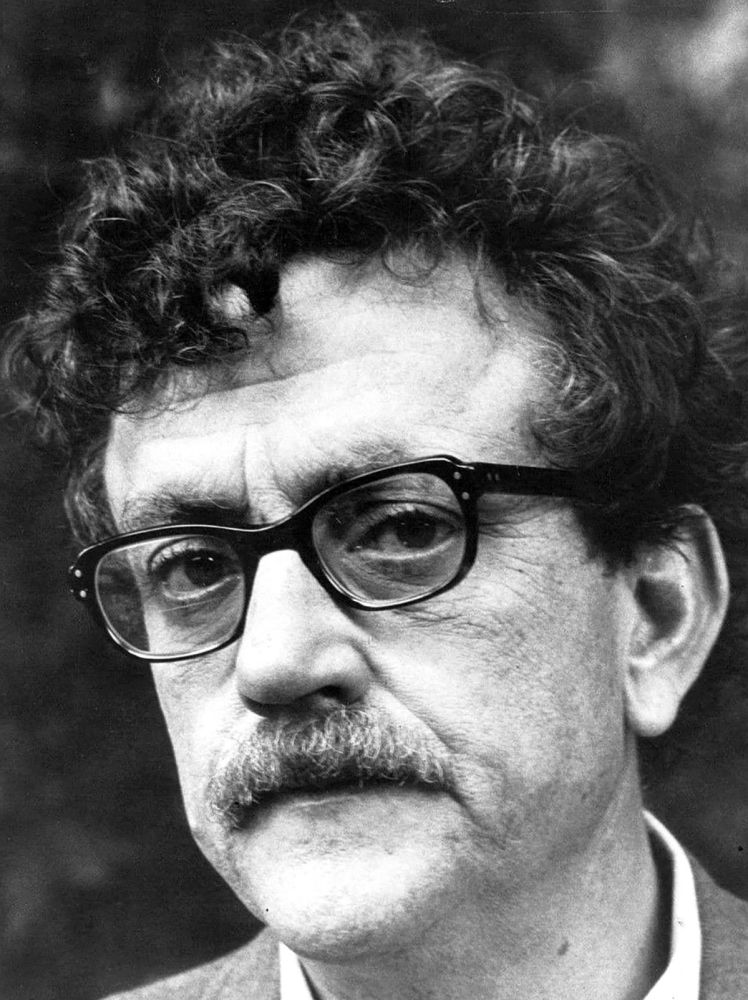 Kurt Vonnegut, ca. 1972. Photograph by PBS
This interview with Kurt Vonnegut was originally a composite of four interviews done with the author over the past decade. The composite has gone through an extensive working over by the subject himself, who looks upon his own spoken words on the page with considerable misgivings… indeed, what follows can be considered an interview conducted with himself, by himself.
The introduction to the first of the incorporated interviews (done in West Barnstable, Massachusetts, when Vonnegut was forty-four) reads: “He is a veteran and a family man, large-boned, loose-jointed, at ease. He camps in an armchair in a shaggy tweed jacket, Cambridge gray flannels, a blue Brooks Brothers shirt, slouched down, his hands stuffed into his pockets. He shells the interview with explosive coughs and sneezes, windages of an autumn cold and a lifetime of heavy cigarette smoking. His voice is a resonant baritone, Midwestern, wry in its inflections. From time to time he issues the open, alert smile of a man who has seen and reserved within himself almost everything: depression, war, the possibility of violent death, the inanities of corporate public relations, six children, an irregular income, long-delayed recognition.
The last of the interviews that made up the composite was conducted during the summer of 1976, years after the first. The description of him at this time reads: “… he moves with the low-keyed amiability of an old family dog. In general, his appearance is tousled: the long curly hair, moustache, and sympathetic smile suggest a man at once amused and saddened by the world around him. He has rented the Gerald Murphy house for the summer. He works in the little bedroom at the end of a hall where Murphy, artist, bon vivant, and friend to the artistic great, died in 1964. From his desk Vonnegut can look out onto the front lawn through a small window; behind him is a large, white canopy bed. On the desk next to the typewriter is a copy of Andy Warhol’s Interview, Clancy Sigal’s Zone of the Interior, and several discarded cigarette packs.
“Vonnegut has chain-smoked Pall Malls since 1936 and during the course of the interview he smokes the better part of one pack. His voice is low and gravelly, and as he speaks, the incessant procedure of lighting the cigarettes and exhaling smoke is like punctuation in his conversation. Other distractions, such as the jangle of the telephone and the barking of a small, shaggy dog named ‘Pumpkin’, do not detract from Vonnegut’s good-natured disposition. Indeed, as Dan Wakefield once said of his fellow Shortridge High School alumnus, ‘He laughed a lot and was kind to everyone.’”
INTERVIEWER
You are a veteran of the Second World War?
VONNEGUT
Yes. I want a military funeral when I die—the bugler, the flag on the casket, the ceremonial firing squad, the hallowed ground.
INTERVIEWER
Why?
VONNEGUT
It will be a way of achieving what I’ve always wanted more than anything—something I could have had, if only I’d managed to get myself killed in the war.
INTERVIEWER
Which is—?
VONNEGUT
The unqualified approval of my community.
INTERVIEWER
You don’t feel that you have that now?
VONNEGUT
My relatives say that they are glad I’m rich, but that they simply cannot read me.
INTERVIEWER
You were an infantry battalion scout in the war?
VONNEGUT
Yes, but I took my basic training on the 240-millimeter howitzer.
INTERVIEWER
A rather large weapon.
VONNEGUT
The largest mobile field piece in the Army at that time. This weapon came in six pieces, each piece dragged wallowingly by a Caterpillar tractor. Whenever we were told to fire it, we had to build it first. We practically had to invent it. We lowered one piece on top of another, using cranes and jacks. The shell itself was about nine-and-a-half inches in diameter and weighed three hundred pounds. We constructed a miniature railway which would allow us to deliver the shell from the ground to the breech, which was about eight feet above grade. The breech-block was like the door on the vault of a savings and loan association in Peru, Indiana, say.
INTERVIEWER
It must have been a thrill to fire such a weapon.
VONNEGUT
Not really. We would put the shell in there, and then we would throw in bags of very slow and patient explosives. They were damp dog biscuits, I think. We would close the breech, and then trip a hammer which hit a fulminate of mercury percussion cap, which spit fire at the damp dog biscuits. The main idea, I think, was to generate steam. After a while, we could hear these cooking sounds. It was a lot like cooking a turkey. In utter safety, I think, we could have opened the breechblock from time to time, and basted the shell. Eventually, though, the howitzer always got restless. And finally it would heave back on its recoil mechanism, and it would have to expectorate the shell. The shell would come floating out like the Goodyear blimp. If we had had a stepladder, we could have painted “Fuck Hitler” on the shell as it left the gun. Helicopters could have taken after it and shot it down.
INTERVIEWER
The ultimate terror weapon.
VONNEGUT
Of the Franco-Prussian War.
INTERVIEWER
But you were ultimately sent overseas not with this instrument but with the 106th Infantry Division—
VONNEGUT
“The Bag Lunch Division.” They used to feed us a lot of bag lunches. Salami sandwiches. An orange.
INTERVIEWER
In combat?
VONNEGUT
When we were still in the States.
INTERVIEWER
While they trained you for the infantry?
VONNEGUT
I was never trained for the infantry. Battalion scouts were elite troops, see. There were only six in each battalion, and nobody was very sure about what they were supposed to do. So we would march over to the rec room every morning, and play Ping-Pong and fill out applications for Officer Candidate School.
INTERVIEWER
During your basic training, though, you must have been familiarized with weapons other than the howitzer.
VONNEGUT
If you study the 240-millimeter howitzer, you don’t even have time left over for a venereal disease film.
INTERVIEWER
What happened when you reached the front?
VONNEGUT
I imitated various war movies I’d seen.
INTERVIEWER
Did you shoot anybody in the war?
VONNEGUT
I thought about it. I did fix my bayonet once, fully expecting to charge.
INTERVIEWER
Did you charge?
VONNEGUT
No. If everybody else had charged, I would have charged, too. But we decided not to charge. We couldn’t see anybody.
INTERVIEWER
This was during the Battle of the Bulge, wasn’t it? It was the largest defeat of American arms in history.
VONNEGUT
Probably. My last mission as a scout was to find our own artillery. Usually, scouts go out and look for enemy stuff. Things got so bad that we were finally looking for our own stuff. If I’d found our own battalion commander, everybody would have thought that was pretty swell.
INTERVIEWER
Do you mind describing your capture by the Germans?
VONNEGUT
Gladly. We were in this gully about as deep as a World War I trench. There was snow all around. Somebody said we were probably in Luxembourg. We were out of food.
INTERVIEWER
Who was “we”?
VONNEGUT
Our battalion scouting unit. All six of us. And about fifty people we’d never met before. The Germans could see us, because they were talking to us through a loudspeaker. They told us our situation was hopeless, and so on. That was when we fixed bayonets. It was nice there for a few minutes.
INTERVIEWER
How so?
VONNEGUT
Being a porcupine with all those steel quills. I pitied anybody who had to come in after us.
INTERVIEWER
But they came in anyway?
VONNEGUT
No. They sent in eighty-eight millimeter shells instead. The shells burst in the treetops right over us. Those were very loud bangs right over our heads. We were showered with splintered steel. Some people got hit. Then the Germans told us again to come out. We didn’t yell “Nuts” or anything like that. We said, “Okay,” and “Take it easy,” and so on. When the Germans finally showed themselves, we saw they were wearing white camouflage suits. We didn’t have anything like that. We were olive drab. No matter what season it was, we were olive drab.
INTERVIEWER
What did the Germans say?
VONNEGUT
They said the war was all over for us, that we were lucky, that we could now be sure we would live through the war, which was more than they could be sure of. As a matter of fact, they were probably killed or captured by Patton’s Third Army within the next few days. Wheels within wheels.
INTERVIEWER
Did you speak any German?
VONNEGUT
I had heard my parents speak it a lot. They hadn’t taught me how to do it, since there had been such bitterness in America against all things German during the First World War. I tried a few words I knew on our captors, and they asked me if I was of German ancestry, and I said, “Yes.” They wanted to know why I was making war against my brothers.
INTERVIEWER
And you said—?
VONNEGUT
I honestly found the question ignorant and comical. My parents had separated me so thoroughly from my Germanic past that my captors might as well have been Bolivians or Tibetans, for all they meant to me.
INTERVIEWER
After you were captured, you were shipped to Dresden?
VONNEGUT
In the same boxcars that had brought up the troops that captured us—probably in the same boxcars that had delivered Jews and Gypsies and Jehovah’s Witnesses and so on to the extermination camps. Rolling stock is rolling stock. British mosquito bombers attacked us at night a few times. I guess they thought we were strategic materials of some kind. They hit a car containing most of the officers from our battalion. Every time I say I hate officers, which I still do fairly frequently, I have to remind myself that practically none of the officers I served under survived. Christmas was in there somewhere.
INTERVIEWER
And you finally arrived in Dresden.
VONNEGUT
In a huge prison camp south of Dresden first. The privates were separated from the non-coms and officers. Under the articles of the Geneva Convention, which is a very Edwardian document, privates were required to work for their keep. Everybody else got to languish in prison. As a private, I was shipped to Dresden . . .
INTERVIEWER
What were your impressions of the city itself before the bombing?
VONNEGUT
The first fancy city I’d ever seen. A city full of statues and zoos, like Paris. We were living in a slaughterhouse, in a nice new cement-block hog barn. They put bunks and straw mattresses in the barn, and we went to work every morning as contract labor in a malt syrup factory. The syrup was for pregnant women. The damned sirens would go off and we’d hear some other city getting it—whump a whump a whumpa whump. We never expected to get it. There were very few air-raid shelters in town and no war industries, just cigarette factories, hospitals, clarinet factories. Then a siren went off—it was February 13, 1945—and we went down two stories under the pavement into a big meat locker. It was cool there, with cadavers hanging all around. When we came up the city was gone.
INTERVIEWER
You didn’t suffocate in the meat locker?
VONNEGUT
No. It was quite large, and there weren’t very many of us. The attack didn’t sound like a hell of a lot either. Whump. They went over with high explosives first to loosen things up, and then scattered incendiaries. When the war started, incendiaries were fairly sizable, about as long as a shoebox. By the time Dresden got it, they were tiny little things. They burnt the whole damn town down.
INTERVIEWER
What happened when you came up?
VONNEGUT
Our guards were non-coms—a sergeant, a corporal, and four privates—and leaderless. Cityless, too, because they were Dresdeners who’d been shot up on the front and sent home for easy duty. They kept us at attention for a couple of hours. They didn’t know what else to do. They’d go over and talk to each other. Finally we trekked across the rubble and they quartered us with some South Africans in a suburb. Every day we walked into the city and dug into basements and shelters to get the corpses out, as a sanitary measure. When we went into them, a typical shelter, an ordinary basement usually, looked like a streetcar full of people who’d simultaneously had heart failure. Just people sitting there in their chairs, all dead. A firestorm is an amazing thing. It doesn’t occur in nature. It’s fed by the tornadoes that occur in the midst of it and there isn’t a damned thing to breathe. We brought the dead out. They were loaded on wagons and taken to parks, large, open areas in the city which weren’t filled with rubble. The Germans got funeral pyres going, burning the bodies to keep them from stinking and from spreading disease. 130,000 corpses were hidden underground. It was a terribly elaborate Easter-egg hunt. We went to work through cordons of German soldiers. Civilians didn’t get to see what we were up to. After a few days the city began to smell, and a new technique was invented. Necessity is the mother of invention. We would bust into the shelter, gather up valuables from people’s laps without attempting identification, and turn the valuables over to guards. Then soldiers would come in with a flamethrower and stand in the door and cremate the people inside. Get the gold and jewelry out and then burn everybody inside.
INTERVIEWER
What an impression on someone thinking of becoming a writer!
VONNEGUT
It was a fancy thing to see, a startling thing. It was a moment of truth, too, because American civilians and ground troops didn’t know American bombers were engaged in saturation bombing. It was kept a secret until very close to the end of the war. One reason they burned down Dresden is that they’d already burned down everything else. You know: “What’re we going to do tonight?” Here was everybody all set to go, and Germany still fighting, and this machinery for burning down cities was being used. It was a secret, burning down cities—boiling pisspots and flaming prams. There was all this hokum about the Norden bomb sight. You’d see a newsreel showing a bombardier with an MP on either side of him holding a drawn .45. That sort of nonsense, and hell, all they were doing was just flying over cities, hundreds of airplanes, and dropping everything. When I went to the University of Chicago after the war the guy who interviewed me for admission had bombed Dresden. He got to that part of my life story and he said, “Well, we hated to do it.” The comment sticks in my mind.
INTERVIEWER
Another reaction would be, “We were ordered to do it.”
VONNEGUT
His was more humane. I think he felt the bombing was necessary, and it may have been. One thing everybody learned is how fast you can rebuild a city. The engineers said it would take 500 years to rebuild Germany. Actually it took about 18 weeks.
INTERVIEWER
Did you intend to write about it as soon as you went through the experience?
VONNEGUT
When the city was demolished I had no idea of the scale of the thing… Whether this was what Bremen looked like or Hamburg, Coventry… I’d never seen Coventry, so I had no scale except for what I’d seen in movies. When I got home (I was a writer since I had been on the Cornell Sun, except that was the extent of my writing) I thought of writing my war story, too. All my friends were home; they’d had wonderful adventures, too. I went down to the newspaper office, the Indianapolis News, and looked to find out what they had about Dresden. There was an item about half an inch long, which said our planes had been over Dresden and two had been lost. And so I figured, well, this really was the most minor sort of detail in World War II. Others had so much more to write about. I remember envying Andy Rooney, who jumped into print at that time; I didn’t know him, but I think he was the first guy to publish his war story after the war; it was called Air Gunner. Hell, I never had any classy adventure like that. But every so often I would meet a European and we would be talking about the war and I would say I was in Dresden; he’d be astonished that I’d been there, and he’d always want to know more. Then a book by David Irving was published about Dresden, saying it was the largest massacre in European history. I said, By God, I saw something after all! I would try to write my war story, whether it was interesting or not, and try to make something out of it. I describe that process a little in the beginning of Slaughterhouse Five; I saw it as starring John Wayne and Frank Sinatra. Finally, a girl called Mary O’Hare, the wife of a friend of mine who’d been there with me, said, “You were just children then. It’s not fair to pretend that you were men like Wayne and Sinatra, and it’s not fair to future generations, because you’re going to make war look good.” That was a very important clue to me.
INTERVIEWER
That sort of shifted the whole focus…
VONNEGUT
She freed me to write about what infants we really were: 17, 18, 19, 20, 21. We were baby-faced, and as a prisoner of war I don’t think I had to shave very often. I don’t recall that that was a problem.
INTERVIEWER
One more war question: Do you still think about the firebombing of Dresden at all?
VONNEGUT
I wrote a book about it, called Slaughterhouse Five. The book is still in print, and I have to do something about it as a businessman now and then. Marcel Ophuls asked me to be in his film, The Memory of Justice. He wanted me to talk about Dresden as an atrocity. I told him to talk to my friend Bernard V. O’Hare, Mary’s husband, instead, which he did. O’Hare was a fellow battalion scout, and then a fellow prisoner of war. He’s a lawyer in Pennsylvania now.
INTERVIEWER
Why didn’t you wish to testify?
VONNEGUT
I had a German name. I didn’t want to argue with people who thought Dresden should have been bombed to hell. All I ever said in my book was that Dresden, willy-nilly, was bombed to hell.
INTERVIEWER
It was the largest massacre in European history?
VONNEGUT
It was the fastest killing of large numbers of people—one hundred and thirty-five thousand people in a matter of hours. There were slower schemes for killing, of course.
INTERVIEWER
The death camps.
VONNEGUT
Yes—in which millions were eventually killed. Many people see the Dresden massacre as correct and quite minimal revenge for what had been done by the camps. Maybe so. As I say, I never argue that point. I do note in passing that the death penalty was applied to absolutely anybody who happened to be in the undefended city—babies, old people, the zoo animals, and thousands upon thousands of rabid Nazis, of course, and, among others, my best friend Bernard V. O’Hare and me. By all rights, O’Hare and I should have been part of the body count. The more bodies, the more correct the revenge.
INTERVIEWER
The Franklin Library is bringing out a deluxe edition of Slaughterhouse Five, I believe.
VONNEGUT
Yes. I was required to write a new introduction for it.
INTERVIEWER
Did you have any new thoughts?
VONNEGUT
I said that only one person on the entire planet benefited from the raid, which must have cost tens of millions of dollars. The raid didn’t shorten the war by half a second, didn’t weaken a German defense or attack anywhere, didn’t free a single person from a death camp. Only one person benefited—not two or five or ten. Just one.
INTERVIEWER
And who was that?
VONNEGUT
Me. I got three dollars for each person killed. Imagine that.
INTERVIEWER
How much affinity do you feel toward your contemporaries?
VONNEGUT
My brother and sister writers? Friendly, certainly. It’s hard for me to talk to some of them, since we seem to be in very different sorts of businesses. This was a mystery to me for a while, but then Saul Steinberg—
INTERVIEWER
The graphic artist?
VONNEGUT
Indeed. He said that in almost all arts, there were some people who responded strongly to art history, to triumphs and fiascoes and experiments of the past, and others who did not. I fell into the second group, and had to. I couldn’t play games with my literary ancestors, since I had never studied them systematically. My education was as a chemist at Cornell and then an anthropologist at the University of Chicago. Christ—I was thirty-five before I went crazy about Blake, forty before I read Madame Bovary, forty-five before I’d even heard of Céline. Through dumb luck, I read Look Homeward, Angel exactly when I was supposed to.
INTERVIEWER
When?
VONNEGUT
At the age of eighteen.
INTERVIEWER
So you’ve always been a reader?
VONNEGUT
Yes. I grew up in a house crammed with books. But I never had to read a book for academic credit, never had to write a paper about it, never had to prove I’d understood it in a seminar. I am a hopelessly clumsy discusser of books. My experience is nil.
INTERVIEWER
Which member of your family had the most influence on you as a writer?
VONNEGUT
My mother, I guess. Edith Lieber Vonnegut. After our family lost almost all of its money in the Great Depression, my mother thought she might make a new fortune by writing for the slick magazines. She took short story courses at night. She studied magazines the way gamblers study racing forms.
INTERVIEWER
She’d been rich at one time?
VONNEGUT
My father, an architect of modest means, married one of the richest girls in town. It was a brewing fortune based on Lieber Lager Beer and then Gold Medal Beer. Lieber Lager became Gold Medal after winning a prize at some Paris exposition.
INTERVIEWER
It must have been a very good beer.
VONNEGUT
Long before my time. I never tasted any. It had a secret ingredient, I know. My grandfather and his brewmaster wouldn’t let anybody watch while they put it in.
INTERVIEWER
Do you know what it was?
VONNEGUT
Coffee.
INTERVIEWER
So your mother studied short-story writing—
VONNEGUT
And my father painted pictures in a studio he’d set up on the top floor of the house. There wasn’t much work for architects during the Great Depression—not much work for anybody. Strangely enough, though, Mother was right: Even mediocre magazine writers were making money hand over fist.
INTERVIEWER
So your mother took a very practical attitude toward writing.
VONNEGUT
Not to say crass. She was a highly intelligent, cultivated woman, by the way. She went to the same high school I did, and was one of the few people who got nothing but A-pluses while she was there. She went east to a finishing school after that, and then traveled all over Europe. She was fluent in German and French. I still have her high-school report cards somewhere. “A-plus, A-plus, A-plus…” She was a good writer, it turned out, but she had no talent for the vulgarity the slick magazines required. Fortunately, I was loaded with vulgarity, so, when I grew up, I was able to make her dream come true. Writing for Collier’s and The Saturday Evening Post and Cosmopolitan and Ladies’ Home Journal and so on was as easy as falling off a log for me. I only wish she’d lived to see it. I only wish she’d lived to see all her grandchildren. She has ten. She didn’t even get to see the first one. I made another one of her dreams come true: I lived on Cape Cod for many years. She always wanted to live on Cape Cod. It’s probably very common for sons to try to make their mothers’ impossible dreams come true. I adopted my sister’s sons after she died, and it’s spooky to watch them try to make her impossible dreams come true.
INTERVIEWER
What were your sister’s dreams like?
VONNEGUT
She wanted to live like a member of The Swiss Family Robinson, with impossibly friendly animals in impossibly congenial isolation. Her oldest son, Jim, has been a goat farmer on a mountaintop in Jamaica for the past eight years. No telephone. No electricity.
INTERVIEWER
The Indianapolis high school you and your mother attended—
VONNEGUT
And my father. Shortridge High.
INTERVIEWER
It had a daily paper, I believe.
VONNEGUT
Yes. The Shortridge Daily Echo. There was a print shop right in the school. Students wrote the paper. Students set the type. After school.
INTERVIEWER
You just laughed about something.
VONNEGUT
It was something dumb I remembered about high school. It doesn’t have anything to do with writing.